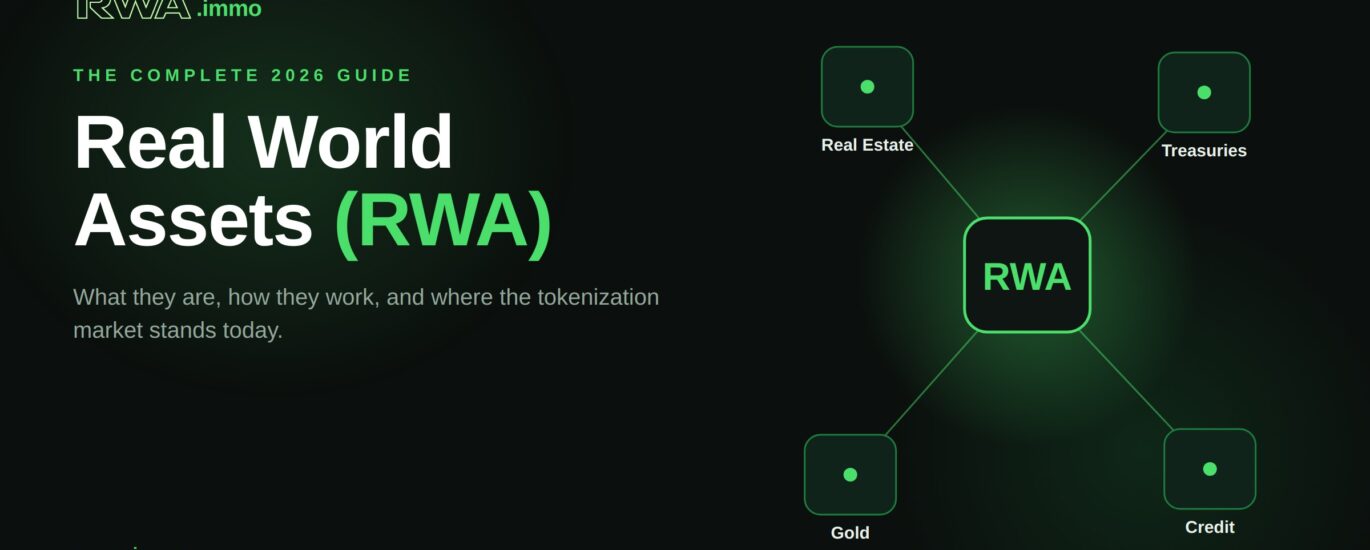
Real world assets (RWA) are traditional, off-chain assets — such as real estate, government bonds, private credit, commodities and company shares — represented as tokens on a blockchain. In simple terms, an RWA takes something that already has value in the physical or financial world and gives it a secure, programmable digital form that can be owned, transferred and settled on-chain.
Once a niche experiment, real world assets have become one of the fastest-growing corners of digital finance. As of 1 July 2026, more than $31 billion of real world assets (excluding stablecoins) were live on public blockchains, according to the analytics platform rwa.xyz — a rise of more than 260% in a single year. This guide explains what real world assets are, how they are tokenized, the main types, how large the market has become, and the benefits and risks to understand before you get involved.
Key takeaways
- Real world assets (RWA) are real, off-chain assets tokenized on a blockchain.
- The on-chain RWA market passed $31 billion (excluding stablecoins) by mid-2026.
- Tokenized US Treasuries and private credit lead today; real estate is the largest untapped opportunity.
- The main benefits are liquidity, fractional ownership, transparency and faster settlement.
- The main risks are thin secondary-market liquidity, evolving regulation and the gap between economic exposure and legal ownership.
What are real world assets (RWA)?
The term real world assets refers to any asset that exists outside a blockchain but is issued or recorded on one as a digital token. The token acts as a claim on — or a direct representation of — the underlying asset, whether that is an apartment building, a US Treasury bill, a barrel of oil, a loan, or a share in a fund.
“RWA” is the widely used shorthand for this category. It stands in contrast to native crypto-assets such as Bitcoin, which have no off-chain counterpart. A real world asset, by design, is backed by something tangible or contractual in the traditional economy, and its value is tied to that underlying asset rather than to market sentiment alone.
The idea is not new — securities have been recorded electronically for decades. What is new is doing it on a shared, programmable ledger, so that ownership, compliance rules and settlement can be built directly into the asset itself.
How real world assets are tokenized
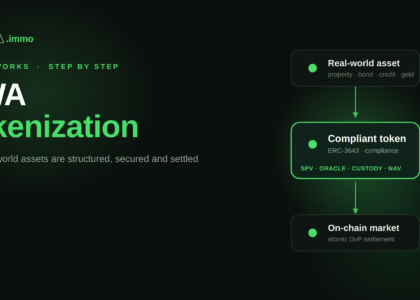
Tokenizing a real world asset generally follows a repeatable path. The asset is placed into a legal structure (often a special-purpose vehicle), a token is issued to represent ownership or economic rights, and rules for who can hold or transfer it are enforced on-chain. A custodian safeguards the underlying asset or its keys, and an oracle feeds off-chain data — such as valuation or proof of reserves — onto the blockchain.
Done well, this makes the asset easier to divide, distribute and settle, while keeping it compliant with securities law. We cover the full process, including token standards and custody, in our guide to RWA tokenization.
The main types of real world assets
The RWA market is no longer a single category. By 2026 at least six distinct classes each hold more than $1 billion in on-chain value. The most important are:
- Tokenized US Treasuries. The largest and most mature category, offering low-risk, yield-bearing exposure to short-term government debt. BlackRock’s tokenized fund, BUIDL, alone passed $2.4 billion in assets.
- Private credit. Loans to businesses and consumers — including trade finance and asset-backed lending — packaged as on-chain tokens that pay real yield.
- Commodities. Tokenized gold leads here, letting investors hold a claim on physical metal with the liquidity of a digital token.
- Equities and funds. Tokenized stocks, ETFs and money-market funds that track the return of the underlying security.
- Bonds. Corporate and government bonds issued or mirrored on-chain.
- Real estate. Property and property-backed instruments — the category with the most retail appeal and, so far, the slowest institutional adoption.
Together these show how far real world assets have moved beyond a single use case toward a diversified market.
How big is the RWA market in 2026?
The growth has been steep. On-chain real world assets (excluding stablecoins) climbed from roughly $6.5 billion in early 2025 to more than $31 billion by mid-2026, according to rwa.xyz — growth of over 260% year on year. Include stablecoins and cash equivalents, and the broader tokenized market runs into the hundreds of billions.
Longer-term forecasts vary widely because they measure different things. McKinsey, on the conservative end, projects the tokenized-asset market could reach around $2 trillion by 2030. Boston Consulting Group has put a $16 trillion figure on the table for 2030 — close to 10% of global GDP — while Standard Chartered has suggested $30 trillion by 2034 under aggressive adoption. These are external estimates, not guarantees, and the spread itself is a useful signal: the base case is measured in low-single-digit trillions, and the larger numbers assume tokenization becomes the default way assets are issued.
The honest reading is that real world assets are simultaneously huge in projection and still early in reality — which is precisely where the opportunity lies.
Why real world assets matter
Real world assets aim to fix long-standing frictions in traditional markets. The main benefits are:
- Liquidity. Historically illiquid assets, like a building or a private loan, can be divided into tradable tokens that change hands far more easily than the whole asset.
- Fractional ownership. High-value assets become accessible in small increments, opening markets that were once reserved for institutions and the wealthy.
- Faster settlement. On-chain transfers can settle in minutes with atomic delivery-versus-payment, rather than days through layers of intermediaries.
- Transparency. Ownership, valuation and servicing can be verified on a shared ledger, reducing reconciliation and disputes.
- Real yield. Unlike purely speculative tokens, many real world assets generate income backed by genuine cash flows — rent, interest or coupons.
Real world assets and real estate
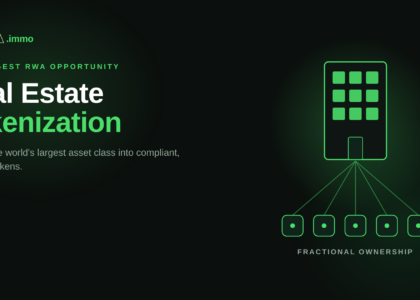
Property is often called the ultimate real world asset: it is the largest asset class on earth, worth hundreds of trillions of dollars, yet it is also one of the most illiquid and hardest to access. Tokenization promises to change that by turning property into compliant, tradable securities.
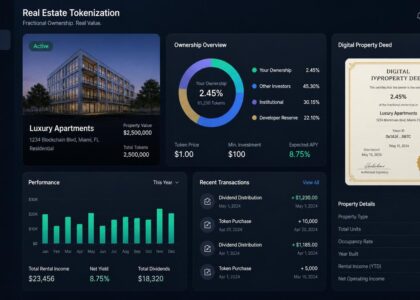
In practice, real estate has been slower to scale than Treasuries or credit. The reason is simple — real estate’s legal complexity does not disappear when you add a token, and most jurisdictions still require conventional title transfer for a genuine change of legal ownership. For now, tokenization works best for fractional economic exposure rather than outright on-chain title. That distinction matters, and it is exactly the problem serious platforms are built to solve. We explore it in depth in our guide to real estate tokenization.
The risks and challenges
Real world assets are promising, but they are not risk-free. Anyone considering them should weigh several challenges:
- Liquidity is not guaranteed. Putting an asset on-chain does not automatically create buyers for it. Many tokenized assets still see low trading volumes, long holding periods and thin secondary markets.
- Regulation is evolving. Rules differ by country and are still being written, which creates uncertainty for issuers and investors alike.
- Custody and security. The value of a token depends on the safekeeping of the underlying asset and the private keys that control it.
- Economic exposure versus legal ownership. In some structures a token grants a claim on returns rather than direct legal title, so it is essential to understand exactly what you own.
None of these are reasons to dismiss the sector — but they are reasons to choose regulated, institution-grade platforms and to do careful due diligence.
The regulatory landscape
Regulation is catching up quickly, and 2026 brought more clarity than any year before it. In the United States, a joint statement from the Securities and Exchange Commission in January 2026 confirmed that existing federal securities laws apply to tokenized securities regardless of whether ownership is recorded on-chain or off-chain, while the GENIUS Act set rules for stablecoins used to settle transactions.
In Europe, the MiCA framework governs crypto-assets, and the EU’s DLT Pilot Regime lets regulated venues trade and settle tokenized securities. Switzerland went further still: its DLT Act created a clear legal basis for “ledger-based securities,” making it one of the most credible jurisdictions in the world for tokenizing real world assets — the foundation on which rwa.immo is built.
How to get started with real world assets
For most people, getting started means choosing what kind of exposure you want, selecting a trustworthy platform, and verifying the essentials — proof of reserves, audits, custody and compliance — before investing. Our practical walkthrough covers each step in how to invest in RWA.
If your interest is specifically property, it is also worth understanding how tokenized real estate compares with traditional vehicles. We break that down in RWA vs REITs, where we look at liquidity, access, fees and ownership side by side.
Frequently asked questions
What does RWA stand for? RWA stands for “real world assets” — real, off-chain assets such as property, bonds, credit or commodities that are represented as tokens on a blockchain.
Are real world assets a good investment? Real world assets can offer real yield and diversification backed by tangible value, but returns and risks vary by asset class and platform. Liquidity and regulation are the key factors to assess, and nothing here is investment advice.
What is the difference between RWA and stablecoins? A stablecoin is a token pegged to a currency and used mainly to move value, while a real world asset represents ownership of, or a claim on, an income-producing or value-bearing asset. Analysts usually measure the RWA market excluding stablecoins.
Is tokenized real estate legal? In many jurisdictions, yes — provided it is structured as a compliant security. Switzerland’s DLT Act and the EU’s frameworks give tokenized property a clear legal basis, though the underlying property law of each country still applies.
The bottom line
Real world assets bring the trillions of dollars locked in traditional markets onto programmable, transparent rails — adding liquidity, access and speed while keeping real value behind every token. The market is still early, liquidity and regulation remain the decisive challenges, and real estate in particular has enormous room to grow.
That is the opportunity rwa.immo is built for: institutional-grade infrastructure to issue, trade and service real world assets in real estate, on the clearest legal foundations available. Explore how real estate tokenization works →
This article is for general information only and is not investment, legal or tax advice. Market figures are sourced from rwa.xyz and cited research as of mid-2026 and will change over time.