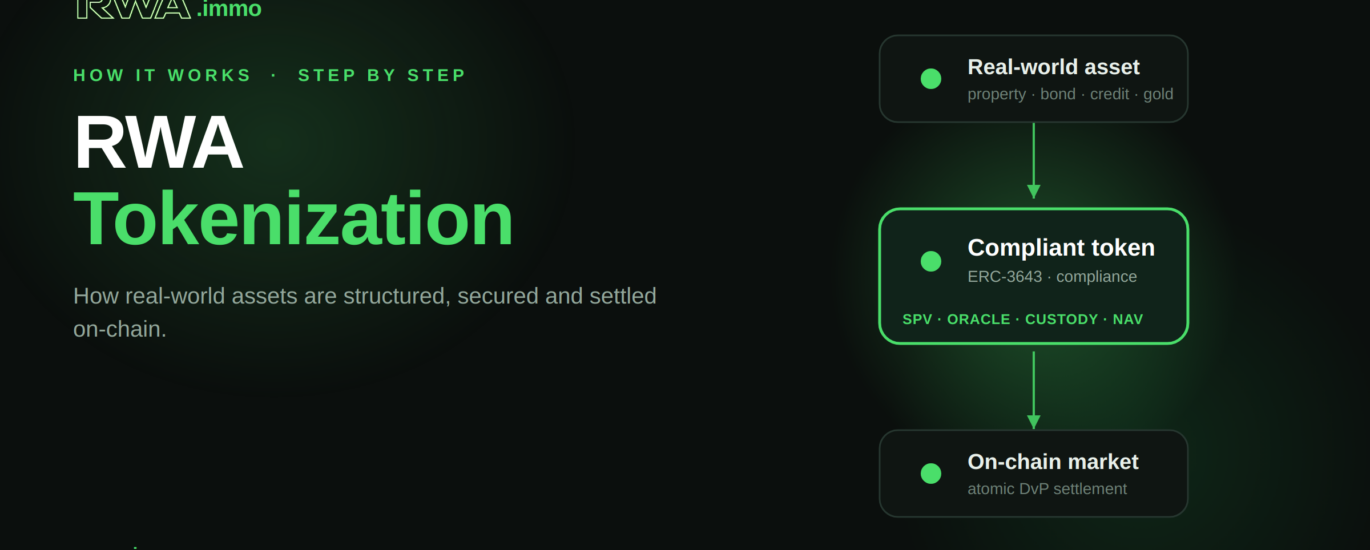
RWA tokenization is the process of turning a real-world asset — such as a building, a bond, a loan or an ounce of gold — into a digital token on a blockchain that represents ownership of, or a claim on, that asset. The token becomes a programmable, transferable version of the asset, while the asset itself continues to exist in the physical or financial world.
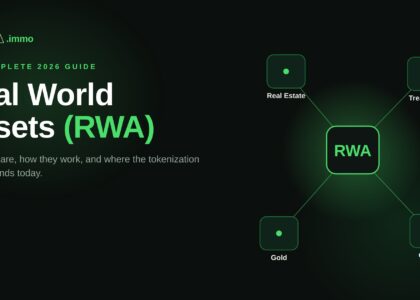
If you are new to the topic, start with our overview of what real world assets are. This guide goes one level deeper and explains exactly how RWA tokenization works — the legal structure, the token standards, the compliance and custody layers, and the steps that take an asset from the real world onto a blockchain.
Key takeaways
- RWA tokenization converts real-world assets into blockchain tokens that represent ownership or economic rights.
- The process combines a legal structure (usually an SPV), a compliant token standard, verified identities, custody and price oracles.
- Permissioned securities-token standards such as ERC-3643 build compliance directly into the token.
- Personal data and legal documents stay off-chain; only tokens and attested facts go on-chain.
- The hardest parts are liquidity, regulation and the gap between economic exposure and legal title.
What is RWA tokenization?
RWA tokenization is the issuance of a blockchain token that stands in for a real-world asset. Instead of tracking ownership in a spreadsheet, a registrar’s database or a paper certificate, ownership is recorded on a shared ledger where transfers, rules and settlement can be automated.
The token is not the asset — it is a legally-backed representation of it. That backing is what separates a genuine tokenized asset from a purely speculative crypto-token: behind every token sits a real building, bond or fund, held in a defined legal structure. Done properly, RWA tokenization keeps the asset fully compliant with securities law while making it easier to divide, transfer and settle.
Why RWA tokenization matters
The appeal of RWA tokenization is that it fixes long-standing frictions in traditional markets. It allows large, illiquid assets to be split into affordable fractions, opens access to investors who were previously excluded, and lets transfers settle in minutes rather than days. It also puts ownership and servicing on a transparent, auditable ledger.
These benefits explain why the sector has grown so quickly — on-chain real-world assets passed $31 billion (excluding stablecoins) by mid-2026, according to rwa.xyz. We cover the market and its benefits in more detail in the pillar guide; here, the focus is the mechanics.
How RWA tokenization works, step by step
Although details vary by asset and jurisdiction, almost every RWA tokenization follows the same nine steps.
1. Select and evaluate the asset. The issuer identifies the asset and confirms it can be tokenized — verifying ownership, valuation, legal status and any encumbrances.
2. Structure the asset legally. The asset is placed into a legal wrapper, typically a special-purpose vehicle (SPV), so that the token can represent a clean claim on it. This step defines exactly what a token holder owns.
3. Choose a token standard. The issuer selects the blockchain and token standard that will govern the asset — most often a permissioned securities standard designed for regulated assets (see below).
4. Build in compliance and identity. Rules for who may hold or receive the token — country, accreditation, KYC/AML status — are encoded so they are checked automatically on every transfer. Verified investor identities are linked to on-chain credentials.
5. Set up custody. A qualified custodian safeguards the underlying asset or the private keys that control the tokens, using institutional controls such as multi-party computation and hardware security modules.
6. Connect oracles. Off-chain data — valuation, net asset value (NAV) and proof that the backing asset exists — is delivered on-chain through oracles, so the token reflects reality and, for asset-backed models, cannot be over-issued.
7. Issue and distribute (primary market). Tokens are minted and sold to verified investors in a primary offering, with subscriptions and settlement handled on-chain.
8. Enable trading and settlement (secondary market). Holders can trade the token, with settlement executed as atomic delivery-versus-payment — the asset and the payment change hands together, or not at all, removing counterparty risk.
9. Service the asset. Over its life the token pays income, processes corporate actions and updates NAV, all recorded transparently on the ledger.
Together these steps are what turn RWA tokenization from a slogan into a working, compliant asset.
The token standards behind RWA tokenization
The token standard is the rulebook the asset lives by. Three matter most:
- ERC-3643 — the leading standard for permissioned security tokens. It enforces compliance at the protocol level: a transfer only succeeds if both parties are verified and the transfer satisfies the asset’s rules. This “compliance-by-construction” approach is why serious RWA tokenization platforms favour it, and the standard is published as an open specification at ERC-3643.
- ERC-1400 / ERC-1404 — earlier security-token frameworks that added transfer restrictions to tokens.
- ERC-20 — the familiar fungible-token standard, suitable for some simpler or wrapped instruments but with no built-in compliance.
For regulated real-world assets, a permissioned standard is essential, because the rules that make the asset legal must travel with the token everywhere it goes.
On-chain versus off-chain: what actually lives where
A common misconception is that RWA tokenization puts everything on the blockchain. In practice, the design deliberately splits the two worlds. The blockchain holds the token, balances, transfer logic and attested facts such as NAV and proof of reserves. Everything sensitive or legally weighty — investor personal data, KYC records, legal agreements and the asset itself — stays off-chain in secure, compliant systems.
This split is not a limitation; it is good design. It keeps personal data private and compliant with data-protection law while still giving the market a transparent, programmable record of ownership.
Public versus permissioned blockchains
RWA tokenization can happen on a public chain, a permissioned chain, or a permissioned network built on public infrastructure. The trade-off is between openness and control. Public chains offer reach and neutrality; permissioned networks offer governance, performance and the ability to meet regulatory requirements around who runs the infrastructure. Many institutional platforms choose a permissioned network that still connects to public liquidity, aiming to get the best of both.
The challenges of RWA tokenization
RWA tokenization is powerful, but it does not remove every problem — and honest platforms say so. The main challenges are:
- Liquidity. Tokenizing an asset does not automatically create buyers. Many tokenized assets still trade thinly, with long holding periods and limited secondary markets.
- Regulation. Rules differ by country and are still evolving, so structuring an asset correctly in each jurisdiction is demanding work.
- Legal title versus economic exposure. In some structures a token grants a share of returns rather than direct legal ownership. Understanding which one you hold is essential.
- Custody and security. The value of a token depends on the safekeeping of the underlying asset and the keys that control it.
None of these are reasons to avoid tokenization — but they are reasons to choose regulated, institution-grade platforms over shortcuts.
RWA tokenization and real estate
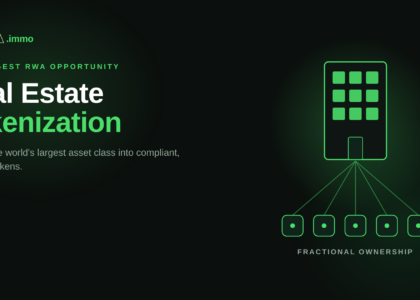
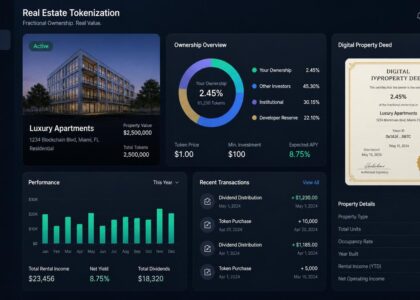
Real estate is one of the most promising — and most demanding — assets to tokenize. Property is enormously valuable but slow, expensive and illiquid to transfer, so the benefits of tokenization are large. At the same time, real estate carries legal complexity that a token cannot erase: most jurisdictions still require conventional title transfer for a true change of legal ownership, so tokenization often delivers fractional economic exposure rather than on-chain title. We explore how this works in practice in our guide to real estate tokenization.
Frequently asked questions
What is RWA tokenization in simple terms? It is the process of creating a blockchain token that represents ownership of, or a claim on, a real-world asset such as property, bonds or commodities, so the asset can be divided, transferred and settled digitally.
Is RWA tokenization legal? Yes, when the asset is structured as a compliant security and issued under the right rules. Frameworks such as Switzerland’s DLT Act and the EU’s regimes give tokenized assets a clear legal basis, though each asset must still follow its local law.
What is the best token standard for RWA tokenization? For regulated assets, permissioned security-token standards such as ERC-3643 are generally preferred because they enforce compliance automatically on every transfer.
Do I own the real asset when I buy a tokenized RWA? It depends on the structure. Some tokens grant direct legal ownership, while others grant economic rights or a share of returns through an SPV. Always check what the token legally represents before investing.
The bottom line
RWA tokenization is the bridge between traditional assets and blockchain rails. It combines a sound legal structure, a compliant token standard, verified identities, institutional custody and reliable oracles to move real value on-chain — safely and transparently. The mechanics are well understood; the remaining work is liquidity, regulation and rigorous execution.
That execution is what rwa.immo is built for: institution-grade RWA tokenization for real estate, on the clearest legal foundations available. Next, see how to invest in RWA or explore real estate tokenization in depth.
This article is for general information only and is not investment, legal or tax advice. Market figures are sourced from rwa.xyz as of mid-2026 and will change over time.